
Commercial Dehumidification Systems in Texas: 5 Myths Debunked for 2026
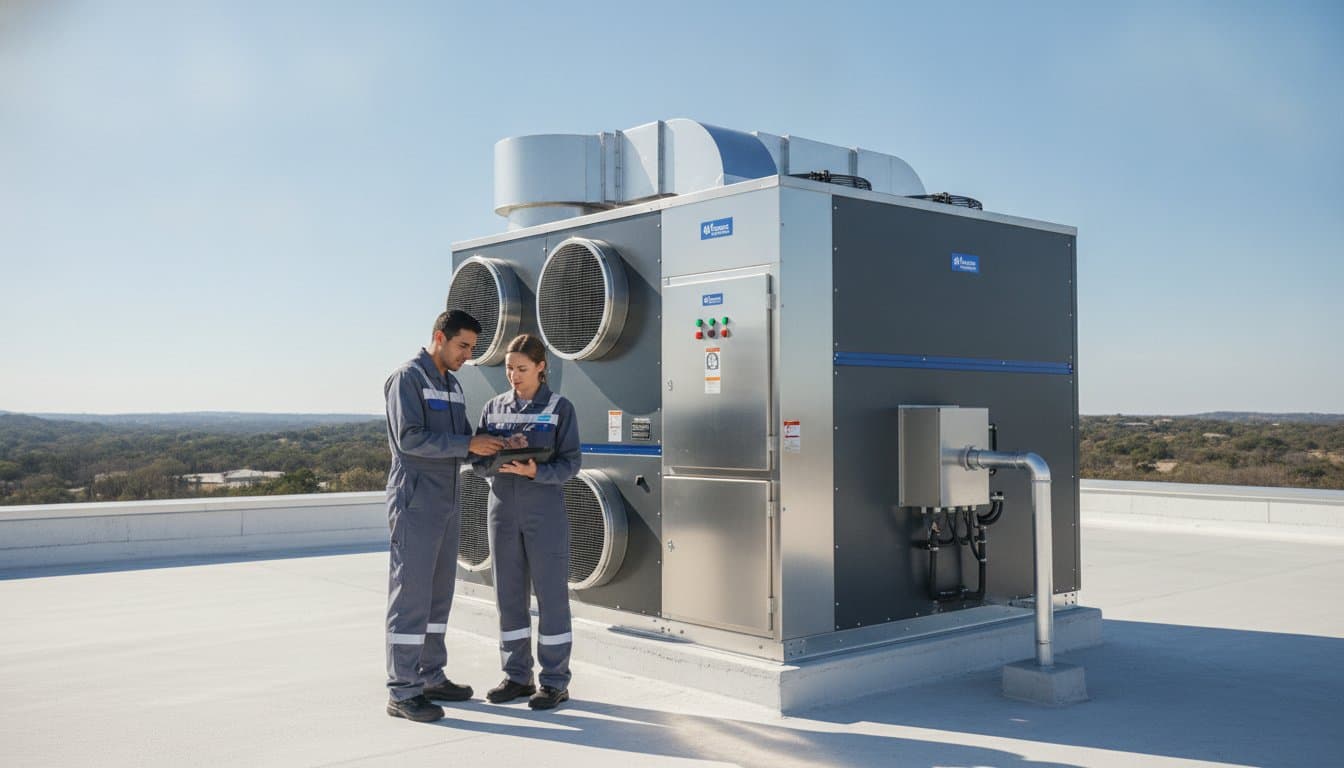
Why does a commercial facility in the Dallas-Fort Worth metroplex often remain damp and uncomfortable despite the air conditioning system operating for more than 2,200 hours annually? You recognize that managing a large-scale building in this climate requires constant vigilance, yet the traditional strategy of lowering the thermostat to remove moisture from the air frequently results in exorbitant energy expenditures and accelerated equipment corrosion. Implementing effective commercial dehumidification systems Texas facilities require involves moving beyond simple cooling to address the specific latent loads that standard HVAC units aren't engineered to handle alone.
By understanding the technical nuances of moisture control, you can transition from reactive maintenance to a proactive strategy of total environmental oversight. This guide provides a transparent, logic-driven analysis of five industry myths that compromise building performance, while highlighting critical 2026 updates such as the mandatory shift to low-GWP refrigerants and new ASHRAE 62.1 ventilation standards. You'll discover how a disciplined approach to mechanical design ensures a stable building envelope, maintains compliance with modern air quality mandates, and protects your critical infrastructure from the long-term risks of uncontrolled humidity.
Key Takeaways
- Distinguish between sensible and latent heat to address the specific moisture loads unique to the Texas Gulf Coast and Central Hill Country.
- Recognize that standard air conditioning units prioritize temperature over moisture removal, making them insufficient as primary dehumidification solutions.
- Avoid the common error of oversizing HVAC equipment, as this leads to short-cycling that fails to adequately process humid air.
- Evaluate the strategic benefits of integrated versus standalone systems to determine the most efficient footprint for your industrial facility.
- Learn how BIM-driven coordination and in-house fabrication ensure that commercial dehumidification systems Texas buildings utilize are installed with technical precision.
Table of Contents
- Navigating the Latent Load: Why Texas Humidity Demands Specialized Systems
- Myth #1: 'My AC System is Already a Dehumidifier'
- Myth #2: 'Oversizing the HVAC Unit Improves Humidity Control'
- Integrated vs. Standalone: Strategic Engineering for Industrial Facilities
- Precision Humidity Management: The J3 Mechanical Fabrication Standard
Navigating the Latent Load: Why Texas Humidity Demands Specialized Systems
Texas climate dynamics present a dual challenge for facility managers, as the state encompasses diverse moisture profiles that vary significantly between the saturated air of the Gulf Coast and the volatile conditions of the Central Texas Hill Country. While sensible heat is easily managed through standard refrigeration cycles, the latent load, or the energy required to remove water vapor, often remains unaddressed in traditional mechanical designs. The 2021 International Energy Conservation Code (IECC) reclassified a significant portion of the state, including the Dallas-Fort Worth metroplex, into Climate Zone 2A, which is categorized as "Hot-Humid." This designation underscores the necessity for commercial dehumidification systems Texas stakeholders must implement to safeguard their building envelopes from structural degradation. When moisture penetrates the building seal, it compromises insulation values and triggers a cycle of energy waste that can't be corrected by simply lowering the thermostat.
Defining Commercial Dehumidification in an Industrial Context
Industrial-grade moisture control is a rigorous application of psychrometrics, the study of the physical and thermodynamic properties of gas-vapor mixtures. Unlike residential units, these systems are engineered to remove moisture measured in pints per hour, ensuring that the dew point remains below the surface temperature of interior materials. Understanding how a dehumidifier works in a large-scale setting reveals that standard HVAC coils often fail during part-load conditions. When the sensible cooling requirement is met, the system cycles off, allowing humidity to rise unchecked and creating a "clammy" environment that violates ASHRAE Standard 62.1-2025 ventilation requirements. Precision in these systems requires a calculated balance between air volume and moisture extraction capacity to maintain a stable indoor environment regardless of external weather shifts.
The Cost of Inaction: Mold, Corrosion, and Compliance
Neglecting latent load management introduces substantial financial risks that manifest as mold growth within HVAC ductwork, corrosion of sensitive electronic components, and non-compliance with evolving 2026 indoor air quality standards. For high-stakes environments like laboratories or schools, the presence of airborne contaminants due to high humidity is a liability that can lead to total facility shutdowns. Precision moisture control prevents the premature mechanical wear of expensive cooling infrastructure, as it eliminates the need to over-cool spaces just to achieve a marginal reduction in humidity. A disciplined approach to these systems ensures that the building operates as a cohesive, protected asset rather than a series of disconnected mechanical components. By prioritizing humidity control as a distinct engineering requirement, facilities can achieve long-term stability and reduced maintenance overhead.
Myth #1: 'My AC System is Already a Dehumidifier'
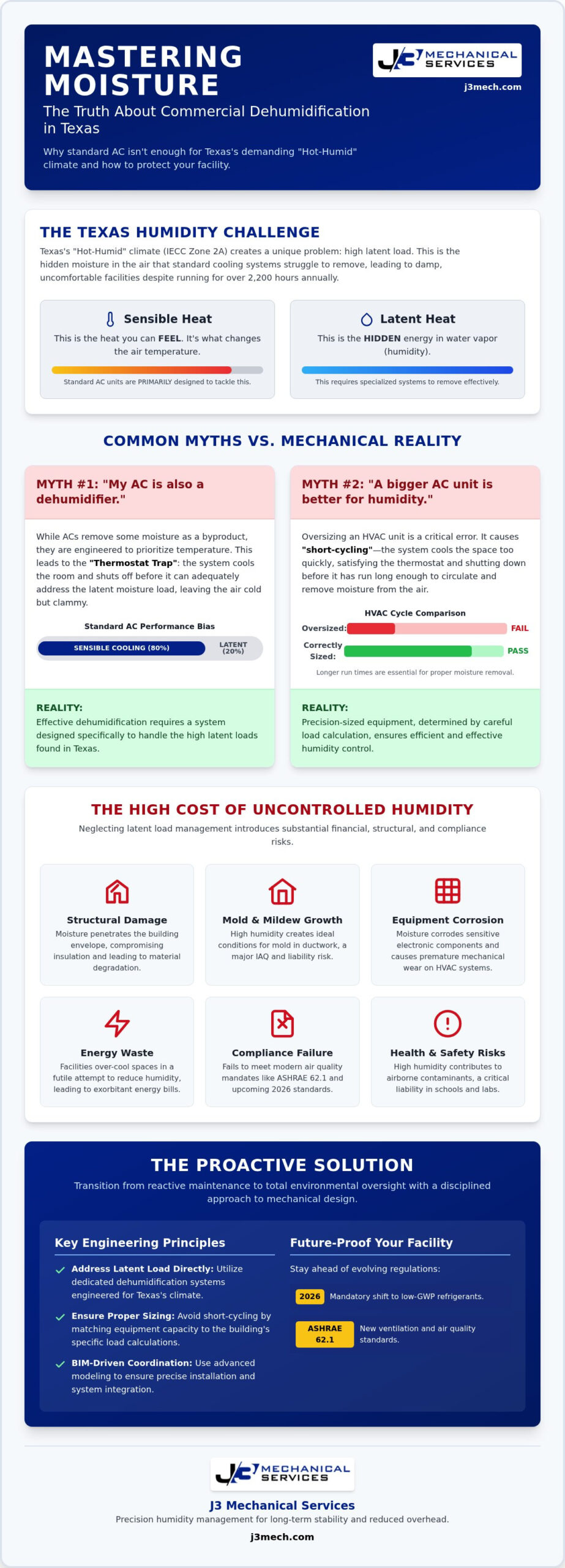
Many facility managers operate under the assumption that a drop in dry-bulb temperature indicates a successful reduction in moisture. This logic fails to account for the fundamental physics of air conditioning, where water vapor removal is merely an incidental byproduct of the cooling process. In high-stakes environments, relying on standard cooling cycles to manage commercial dehumidification systems Texas requirements often results in a building that is cold but remains saturated with moisture. This discrepancy creates the "Thermostat Trap," a phenomenon where the mechanical system satisfies the sensible temperature requirement and shuts down before the latent moisture load has been adequately addressed.
Sensible vs. Latent Cooling: A Framework for Facility Managers
The performance of mechanical equipment is professionally defined by its Latent Heat Ratio (LHR), which measures the capacity of a system to remove moisture relative to its total cooling output. Standard commercial units are typically biased toward sensible cooling. They prioritize lowering the dry-bulb temperature to meet immediate occupant comfort demands. When the thermostat reaches its designated set point, the compressor deactivates, frequently leaving the evaporator coil before it has reached the specific dew point necessary for sustained condensation. This premature termination of the cycle ensures that relative humidity remains above the 60% threshold recommended by ASHRAE. Over time, this failure to extract moisture leads to the "clammy" indoor environments that signal a breakdown in building envelope integrity.
The Necessity of Dedicated Dehumidification Circuits
Managing high-occupancy commercial spaces requires a departure from residential-grade logic, as the constant introduction of outside air and occupant respiration adds significant moisture that standard units cannot process effectively. Advanced commercial hvac solutions address this by utilizing dedicated dehumidification circuits that operate independently of the primary cooling demand. These systems often employ hot gas reheat technology to ensure the supply air remains within a comfortable range while stripping out maximum moisture. Hot gas reheat is the process of using waste heat to stabilize supply air temperature. By rerouting energy that would otherwise be exhausted, the system maintains precise control over both temperature and humidity without the energy waste associated with over-cooling.
A disciplined approach to moisture management views the HVAC system as a critical infrastructure asset rather than a simple utility. Ensuring your facility maintains these rigorous standards requires a partner who understands the complexities of industrial psychrometrics. Regular commercial HVAC maintenance provides the verification necessary to confirm your systems are performing at their peak design capacity. This proactive oversight mitigates the risk of humidity-driven equipment failure and ensures a stable, compliant environment for all building occupants.
Myth #2: 'Oversizing the HVAC Unit Improves Humidity Control'
A pervasive misconception in the Texas industrial sector is the belief that higher tonnage inherently correlates with superior moisture management. In reality, oversizing a system to combat the intense humidity of Climate Zone 2A often yields the opposite result, creating a dysfunctional cycle of rapid cooling and stagnant moisture. When a unit possesses excessive capacity, it reaches the dry-bulb temperature set point far too quickly, triggering a premature shutdown. This process, known as short-cycling, prevents the mechanical system from achieving the sustained run-times necessary for effective moisture extraction. Effective commercial dehumidification systems Texas facilities rely on are built upon the principle of balanced capacity, where the equipment is engineered to match the specific latent load of the building rather than simply overpowering it with raw cooling force.
The "clammy" sensation often reported by building occupants is the physical manifestation of this engineering failure. While the air temperature may drop to 72 degrees in minutes, the relative humidity often remains well above 60% because the evaporator coil didn't stay below the dew point long enough to wring water from the air. Beyond occupant discomfort, short-cycling imposes a significant financial burden. The frequent starting and stopping of heavy-duty compressors leads to accelerated mechanical wear and a sharp increase in energy consumption, as the system consumes the most power during the initial startup phase. Engineering the "right-size" for Texas requires a disciplined analysis of both peak summer loads and the humid shoulder seasons where cooling demand is low but moisture remains high.
The Science of Short-Cycling and Moisture Retention
For an HVAC system to remove moisture, the evaporator coil must remain cold and saturated for an extended duration. If the airflow velocity is too high or the cycle is too brief, the moisture collected on the fins doesn't have sufficient time to gravitate toward the condensate pan; instead, it's often re-evaporated into the airstream when the compressor cycles off. Adhering to rigorous commercial hvac installation protocols ensures that equipment is selected based on precise psychrometric calculations. This methodology prevents the sizing errors that lead to indoor air quality violations and structural moisture damage.
Variable Capacity Systems: A Modern Solution
Modern industrial infrastructure increasingly utilizes variable-speed compressors and sophisticated modulation to address the cycle-on/cycle-off trap. Unlike legacy systems that operate only at 0% or 100% capacity, variable systems can throttle down to lower speeds, allowing for continuous, low-velocity operation that maximizes contact time between the humid air and the cold coil. This sustained operation ensures that the system maintains the dew point even during part-load conditions, such as a rainy morning in Austin or a humid evening in Houston. By prioritizing modulation over sheer size, facility managers can achieve superior humidity control while significantly reducing long-term energy expenditures.
Integrated vs. Standalone: Strategic Engineering for Industrial Facilities
The selection between integrated and standalone commercial dehumidification systems Texas facilities utilize is a strategic engineering decision that dictates long-term operational costs and environmental stability. While some providers view moisture control as a secondary accessory, a disciplined mechanical approach treats it as a core infrastructure requirement. The choice depends entirely on the facility's specific latent load requirements and the existing mechanical footprint. Integrated systems typically leverage the building's central air handlers, incorporating hot gas reheat coils to manage moisture within a single, unified mechanical platform. This consolidated approach is often ideal for retail and high-density office environments where space is at a premium and a streamlined maintenance schedule reduces logistical complexity.
Integrated Systems for High-Efficiency Office and Retail
Leveraging existing air handlers for moisture control provides a cost-effective path for facilities that require moderate humidity management. By integrating hot gas reheat technology directly into the primary airflow, the system can strip moisture without the energy penalty of over-cooling. This integration allows for a single point of control through the Building Automation System (BAS), simplifying the monitoring of ASHRAE 62.1 compliance. For many Texas businesses, this unified platform offers a superior balance of performance and footprint, provided the system is sized accurately to prevent the short-cycling issues previously discussed. It's a solution that prioritizes efficiency by using waste heat from the refrigeration cycle to stabilize supply air temperatures.
Standalone Solutions for Warehouses and Critical Labs
Industrial warehouses and critical laboratories often require standalone solutions to manage massive latent loads that exceed the capacity of standard cooling cycles. These environments frequently employ desiccant wheels to achieve the ultra-low dew points necessary for sensitive manufacturing or pharmaceutical storage. Standalone units provide independent control, allowing facility managers to extract moisture even when the sensible cooling system is dormant. This separation of functions is particularly vital in light of ASHRAE Standard 90.1-2022 Addendum 'cy', which mandates precise humidity sensors and control sequences in Climate Zone 2A. These systems ensure the building envelope remains protected during the humid shoulder seasons when cooling demand is low but the moisture load remains dangerously high.
Executing these complex configurations requires advanced coordination tools to prevent system clashes and costly field modifications. Utilizing Building Information Modeling (BIM) allows for the precise digital mapping of dehumidification ductwork and specialized transitions before a single component arrives on-site. This proactive modeling is complemented by in-house fabrication, which ensures that custom reheat coils and ducting circuits are built to exact specifications. By maintaining total project control from design through execution, you eliminate the risks associated with off-the-shelf components that fail to integrate seamlessly. To ensure your facility's infrastructure is managed with this level of technical mastery, consult with the experts at J3 Mechanical for specialized HVAC installation and BIM-driven coordination.
Precision Humidity Management: The J3 Mechanical Fabrication Standard
Implementing the sophisticated commercial dehumidification systems Texas buildings require necessitates a transition from general contracting to a "Master Builder" methodology that prioritizes technical mastery and accountability. At J3 Mechanical, this approach ensures that every mechanical component, from the primary air handler to the specialized dehumidification circuit, operates as a cohesive unit within the larger building infrastructure. By maintaining total project control, we eliminate the friction often found between design intent and field execution. This disciplined strategy is particularly critical when navigating the 2026 ASHRAE standards, where the margin for error in moisture management has effectively vanished.
BIM Coordination: Eliminating Clashes Before Construction
Precision begins long before the first piece of ductwork is installed through the systematic application of Building Information Modeling (BIM). By visualizing complex dehumidification circuits in a high-fidelity 3D environment, we identify and resolve potential system clashes with existing structural elements or electrical conduits. This digital verification process is essential for retrofitting older Texas facilities where mechanical room space is often severely constrained. Ensuring adequate clearance for maintenance access isn't just a matter of convenience; it's a strategic requirement that reduces long-term labor costs and facilitates easier Commercial HVAC Maintenance. This meticulous preparation streamlines the construction timeline and provides a predictable, logic-driven path to project completion.
The J3 Standard for Texas Facilities
Our commitment to industrial authority extends across the major humidity zones of the state, providing custom-engineered solutions for facilities in San Antonio, Austin, and Corpus Christi. Every project benefits from our in-house fabrication capabilities, where we manufacture airtight, high-performance sheet metal transitions that off-the-shelf components simply can't match. These custom-fit ductwork circuits are vital for maintaining the integrity of dehumidification cycles, preventing the air leakage that compromises indoor air quality and building envelope stability.
Stability doesn't end with the final installation. We provide 24/7 emergency service and rigorous preventive maintenance programs to ensure your critical infrastructure remains compliant and efficient throughout its lifecycle. This proactive oversight mitigates the risk of humidity-driven corrosion and protects your long-term mechanical investment. The next step in securing your building envelope is a professional mechanical system audit to identify latent load vulnerabilities. Contact J3 Mechanical to schedule a comprehensive evaluation of your facility's environmental controls and experience the rigor of a true industrial partner.
Securing Your Facility's Future Through Precision Moisture Control
Navigating the 2026 industrial landscape requires a fundamental shift from simple temperature control to a disciplined strategy of latent load management. You've seen how standard cooling cycles and oversized units fail to address the specific moisture challenges of the Texas climate, often leading to "clammy" environments and accelerated equipment wear. Implementing the specialized commercial dehumidification systems Texas infrastructure demands is the only reliable method for maintaining ASHRAE compliance and protecting your building envelope from the long-term costs of mold and corrosion.
Achieving this level of environmental stability requires a partner who prioritizes technical mastery and accountability. J3 Mechanical combines BIM-coordinated project delivery with in-house fabrication for industrial precision, all supported by a robust 24/7 emergency repair infrastructure. We invite you to Request a Precision Mechanical Audit from J3 Mechanical Services to verify your system's efficiency and identify vulnerabilities before they manifest. Taking a proactive stance on moisture control ensures your facility remains a stable, high-performance asset for years to come.
Frequently Asked Questions
What is the ideal humidity level for a commercial building in Texas?
ASHRAE recommends maintaining indoor relative humidity between 30% and 60% to ensure occupant comfort and prevent microbial growth. In the humid climates of the Texas Gulf Coast and Central Texas, staying within this range is critical for protecting sensitive equipment and building materials from moisture damage. Maintaining these levels requires a disciplined approach to mechanical design that accounts for both sensible and latent heat loads.
Can high humidity cause my commercial AC unit to freeze up?
Excessive indoor humidity can lead to evaporator coil icing if the system is unable to process the latent load effectively. When high moisture levels are combined with restricted airflow or low refrigerant levels, the condensate on the coil can freeze, creating a barrier that prevents heat exchange. This failure often necessitates immediate 24/7 emergency repair to prevent permanent compressor damage and restore the building's environmental stability.
How much energy does a dedicated commercial dehumidifier consume?
The energy consumption of commercial dehumidification systems Texas facilities utilize depends on the specific technology employed, such as integrated hot gas reheat or standalone desiccant units. Integrated systems that utilize waste heat from the refrigeration cycle are significantly more efficient than those relying on electric reheat. Precise energy modeling during the design phase allows facility managers to predict operational costs accurately while ensuring compliance with the 2021 IECC energy codes.
Is a desiccant dehumidifier better than a refrigerant model for Texas warehouses?
Desiccant dehumidifiers are superior for industrial applications requiring very low dew points or in unconditioned warehouses where temperatures may drop below the effective range of refrigerant based systems. While refrigerant models are efficient for standard comfort cooling, desiccant technology uses moisture absorbing materials to manage massive latent loads without relying on a cooling cycle. The choice between these technologies should be based on a rigorous analysis of the facility's specific environmental requirements.
How often should commercial dehumidification systems be serviced?
Industrial moisture control systems should undergo comprehensive maintenance at least twice per year to ensure all components, including sensors and reheat coils, are functioning at peak efficiency. Regular inspections prevent common issues such as clogged condensate lines or sensor drift, which can compromise humidity control. This proactive oversight is a core component of a disciplined facility management strategy, reducing the likelihood of costly, unplanned mechanical failures during peak humidity seasons.
What happens if I ignore high humidity in my facility's ductwork?
Neglecting elevated humidity levels within ductwork leads to persistent mold growth and the accelerated corrosion of mechanical components. These conditions compromise indoor air quality and can result in significant regulatory liabilities, particularly in high occupancy environments like schools or laboratories. Over time, the moisture driven degradation of insulation and structural elements increases long term maintenance costs and necessitates premature system replacement to restore the integrity of the building envelope.
Can I retrofit an existing commercial HVAC system with dehumidification features?
Retrofitting is a viable option for many Texas facilities, often involving the integration of hot gas reheat circuits or the installation of standalone dehumidification units. A thorough mechanical audit is required to determine if the existing air handlers and ductwork can support the added latent load management components. Integrating specialized commercial dehumidification systems Texas facilities rely on into existing frameworks ensures that older infrastructure can meet modern 2026 ASHRAE 62.1 standards without requiring a total system overhaul.
Does BIM modeling help in reducing the cost of dehumidifier installation?
Building Information Modeling (BIM) significantly reduces installation costs by identifying and resolving system clashes in a digital environment before construction begins. This level of technical precision prevents expensive field modifications and ensures that complex dehumidification ductwork fits perfectly within existing mechanical rooms. By streamlining the logistical coordination of the project, BIM provides a predictable timeline and eliminates the waste associated with traditional, non modeled installation methods.
Need a hand with your building's HVAC?
Free quotes and honest answers from licensed commercial technicians across South Texas.