
Commercial Heating and Cooling Repair: Strategic Restoration for Critical Infrastructure
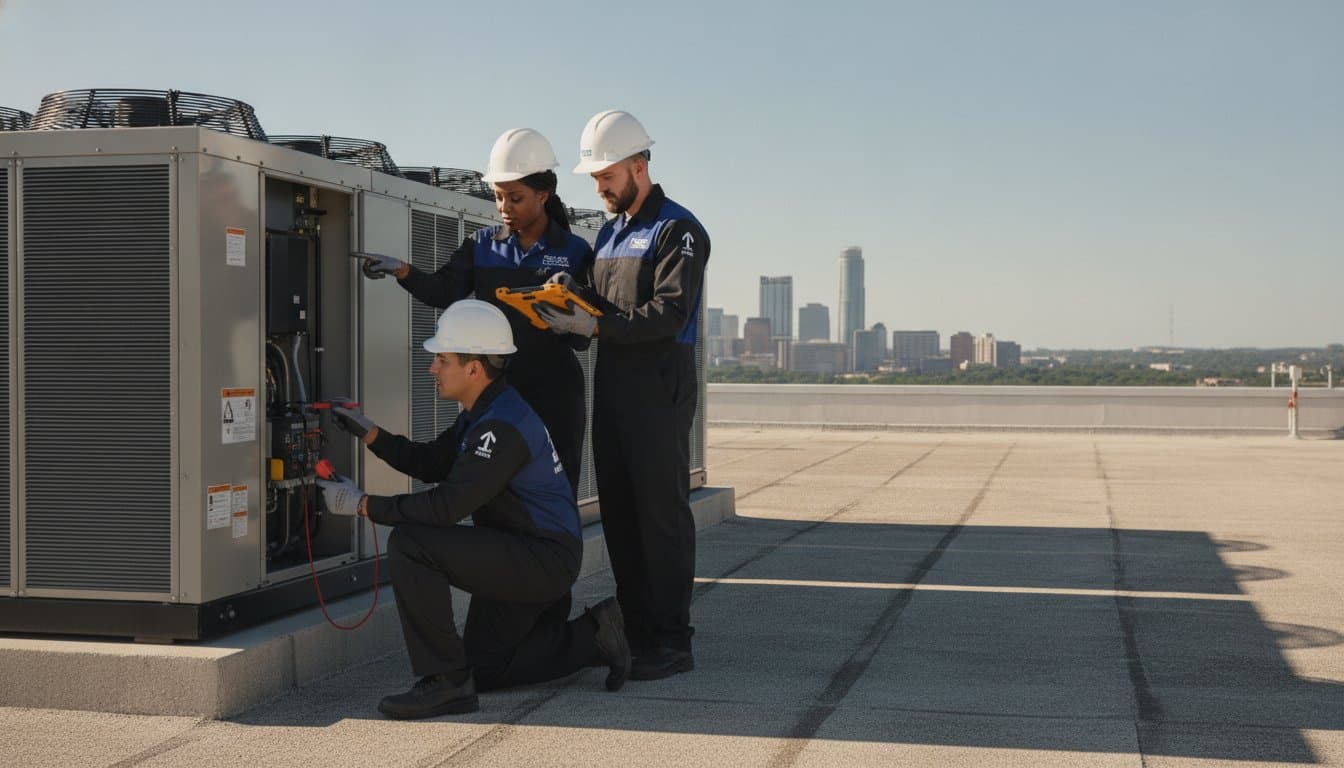
A mechanical failure in a high-capacity facility isn't merely a maintenance ticket; it's a direct threat to your organization's operational integrity and fiscal stability. We recognize that when complex chillers or modular rooftop units fail, the resulting downtime creates a ripple effect of lost revenue and compromised productivity that standard service providers often lack the technical depth to resolve. Securing a reliable partner for commercial heating and cooling repair requires more than a technician with a wrench. It demands a strategist who understands industrial-scale accountability and the specific technical requirements of the 2026 transition to low-GWP refrigerants like R-32 and R-454B.
This guide provides the technical framework you need to identify critical system vulnerabilities and implement restoration strategies that prioritize long-term stability over temporary fixes. We will examine the nuances of A2L refrigerant handling, the integration of Building Information Modeling for rapid diagnostics, and the rigorous verification processes necessary to ensure your infrastructure remains resilient against future disruptions. By the end of this analysis, you'll have a roadmap for navigating high-stakes mechanical failures with the precision and discipline of a master builder.
Key Takeaways
- Analyze the cascading effects of mechanical failure on organizational productivity and equipment longevity to justify strategic infrastructure investments.
- Identify complex failure points within industrial systems, including compressor contamination and localized climate imbalances caused by hidden VAV box malfunctions.
- Implement a systematic approach to commercial heating and cooling repair that employs Building Information Modeling (BIM) to resolve root causes rather than symptoms.
- Execute a high-priority emergency response protocol designed to shed internal heat gains and isolate mechanical faults before they compromise the entire facility.
- Evaluate the benefits of partnering with a specialized mechanical strategist who maintains total focus on industrial-scale accountability and technical precision.
Table of Contents
- High-Stakes Mechanical Failure: The Impact of Commercial Heating and Cooling Disruptions
- Identifying Critical Failure Points in Industrial Mechanical Systems
- Reactive Repair vs. Strategic System Restoration
- Emergency Response Protocol: Navigating HVAC Failures in Texas Facilities
- Professional Recovery: J3 Mechanical's Disciplined Approach to Repair
High-Stakes Mechanical Failure: The Impact of Commercial Heating and Cooling Disruptions
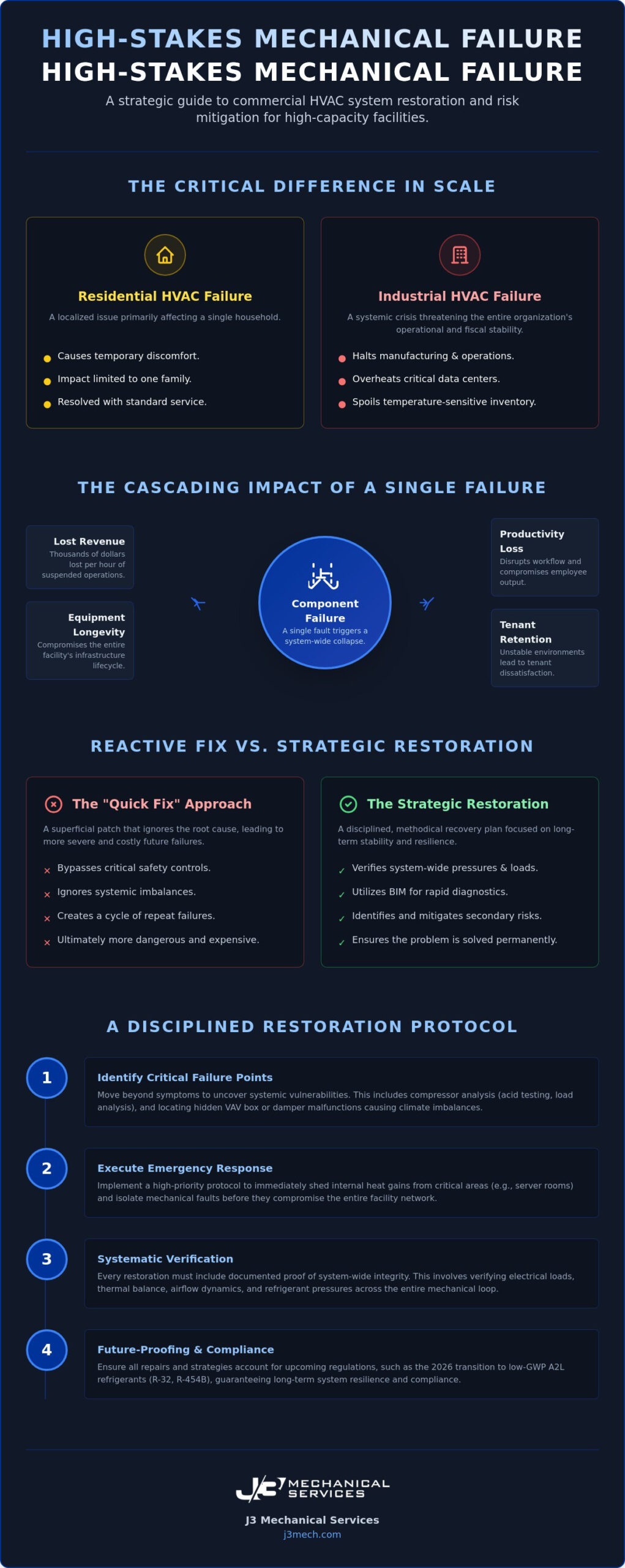
Viewed through the lens of facility management, Heating, ventilation, and air conditioning (HVAC) systems aren't merely amenities that provide comfort. They represent the primary lifeblood of a building's mechanical skeleton. When we discuss commercial heating and cooling repair, we are describing the strategic restoration of critical infrastructure that sustains every facet of a business's operation. Unlike residential units, which operate on a localized scale, industrial mechanical systems are integrated networks where a single component failure can trigger a cascading collapse of environmental control. This collapse impacts employee productivity, tenant retention, and the physical longevity of the building itself.
The diagnostic rigor required for these systems is substantially higher than what's found in the residential sector. Consider the difference in scale between a standard residential split system and a 50-ton industrial rooftop unit. While a residential failure might only require routine maintenance from a service like kcchimney.com, the failure of a high-capacity commercial unit can result in immediate manufacturing halts, the spoilage of temperature-sensitive inventory, or the catastrophic overheating of data centers. The true cost of downtime isn't measured in service fees, but in the thousands of dollars lost per hour when critical processes are suspended.
Operational Continuity and Thermal Stability
For specialized environments such as medical facilities, laboratories, or server rooms, thermal stability isn't optional; it's a regulatory and operational requirement. These spaces often require strict climate parameters to prevent equipment degradation or to maintain sterile conditions. Beyond the immediate atmosphere, the heating and cooling system plays a vital role in preserving the integrity of the building envelope by managing humidity and pressure differentials. Industrial HVAC downtime constitutes a direct threat to the long-term stability and functional lifecycle of the entire facility infrastructure.
The Difference Between a "Fix" and a "Restoration"
In a high-stakes commercial environment, a temporary patch is often more dangerous than the initial failure. Quick fixes that bypass safety controls or ignore systemic imbalances frequently lead to catastrophic failures that are far more expensive to resolve later. A disciplined mechanical recovery plan focuses on total system restoration rather than a superficial repair. This process requires a technician to verify system-wide pressures, electrical loads, and airflow dynamics during every engagement. By transitioning from reactive panic to a methodical verification of root causes, facility managers ensure that their commercial heating and cooling repair is the final word on the problem, not just a pause before the next crisis.
- Systemic Integrity: Every repair must account for the entire mechanical loop, not just the isolated part.
- Verification Standards: Industrial-grade restoration requires documented proof of electrical and thermal load balance.
- Risk Mitigation: Proactive diagnostic rigor identifies secondary vulnerabilities before they manifest as new failures.
Identifying Critical Failure Points in Industrial Mechanical Systems
Industrial mechanical systems operate as high-capacity networks where the synergy between components determines the stability of the entire facility. Identifying critical failure points requires a disciplined diagnostic approach that moves beyond superficial symptoms to uncover systemic vulnerabilities. Compressor failure often serves as the most visible sign of mechanical distress, yet it's frequently the result of upstream issues such as electrical surges or refrigerant contamination. When a large-scale unit's compressor seizes, the root cause must be verified through acid testing and electrical load analysis to prevent a replacement component from suffering the same premature fate.
VAV (Variable Air Volume) boxes and dampers act as the hidden architects of localized climate control. When these components malfunction, they create pressure imbalances that are difficult to diagnose without sophisticated monitoring tools. Similarly, in commercial heating systems, boiler and furnace scaling acts as an unintended insulator, drastically reducing thermal transfer efficiency. This degradation is often tied to water quality issues, which necessitates a systematic review of the facility's chemical treatment protocols during any commercial heating and cooling repair engagement. If a sensor or thermostat loses calibration, the system's "brain" misreads the environment, triggering inefficient short-cycling or insufficient load management. For facilities facing these complex diagnostic challenges, J3 Mechanical Services provides the technical mastery required to restore system accuracy and operational order.
Air Distribution and Ventilation Challenges
Complex ductwork systems are prone to static pressure imbalances that strain blower motors and reduce overall efficiency. Failed economizers represent a significant drain on energy resources, but more importantly, they hinder the building's ability to maintain good indoor air quality. A proactive technician identifies belt and motor fatigue through vibration analysis and thermal imaging before a catastrophic blower failure occurs. This level of foresight is essential for preserving the building envelope and ensuring a healthy environment for all occupants.
Hydronic and Chilled Water System Vulnerabilities
Pump failures in hydronic loops halt thermal distribution instantly, leading to rapid temperature spikes in critical zones. Maintaining a precise chemical balance is the only verified method to avoid internal pipe corrosion that leads to pinhole leaks and restrictive blockages. In the South Texas humidity, cooling towers face unique operational hurdles. Evaporative cooling inefficiencies often stem from scale buildup or biological growth, requiring a disciplined approach to commercial heating and cooling repair to ensure the system handles peak summer loads without friction or mechanical compromise. Facilities that rely on hydronic heating should also ensure their equipment meets current engineering benchmarks, as outlined in our comprehensive guide to commercial boiler installation standards for 2026, which addresses BIM-integrated load calculations and Texas regulatory compliance.
Reactive Repair vs. Strategic System Restoration
A reactive mindset is the primary driver of recurring mechanical failures in high-capacity facilities. Many service providers treat a breakdown as an isolated incident, applying a localized "fix" that ignores the systemic stresses that caused the failure in the first place. When executing a commercial heating and cooling repair, our methodology centers on identifying the catalyst of the failure rather than merely treating the symptom. This root-cause analysis ensures that once a system is restored, the repair remains the final word on the problem. This rigorous approach aligns with the Standard Practice for Inspection and Maintenance, ensuring that every intervention adheres to established engineering benchmarks and restores the equipment to its optimal performance envelope.
Strategic restoration also involves leveraging Building Information Modeling (BIM) to diagnose complex hidden failures, particularly in new construction where mechanical layers are densely integrated. By utilizing digital twin technology, we can visualize the entire mechanical skeleton of a building to trace how a failure in one zone might be linked to a pressure imbalance or electrical fault in another. Every project concludes with a comprehensive system performance audit, verifying that the restored infrastructure meets or exceeds the original design specifications before we consider the mission complete. Developers planning new builds in the region can find a detailed breakdown of these BIM-driven strategies in our guide to hvac new construction in Killeen, which addresses how proactive mechanical planning prevents the costly change orders that plague large-scale projects.
Leveraging Technology for Diagnostic Precision
Precision diagnostics require more than visual inspections. We employ non-invasive tools such as thermal imaging and vibration analysis to detect anomalies within sealed components and complex ductwork. These technologies allow us to identify early-stage motor fatigue or insulation voids without disrupting facility operations. By using digital modeling to trace mechanical issues through the entire facility, we provide a level of transparency and accuracy that standard service calls cannot match. This data-driven process transforms commercial heating and cooling repair from a series of guesses into a controlled engineering operation.
Minizing Lead Times with In-House Fabrication
One of the most significant liabilities in mechanical recovery is the wait time for manufacturer-sourced components. We mitigate this risk through in-house fabrication, allowing us to manufacture custom sheet metal, specialized brackets, and critical components immediately. This capability is a vital logistical advantage for our partners across Central Texas and the Rio Grande Valley, as it facilitates rapid system recovery when standard supply chains fail. By maintaining control over the manufacturing process, in-house fabrication effectively eliminates the risks associated with third-party supply chain delays and manufacturer backorders. This self-performing model ensures that your facility returns to full operational capacity on our timeline, not a manufacturer's shipping schedule.
Emergency Response Protocol: Navigating HVAC Failures in Texas Facilities
When a high-capacity mechanical system ceases to function during peak demand, the facility manager's initial actions dictate the trajectory of the recovery mission. A disciplined protocol transforms a chaotic failure into a managed restoration process, ensuring that the integrity of the building envelope is preserved while technicians are en route. Executing a successful commercial heating and cooling repair in an emergency scenario requires a synchronized effort that begins long before a contractor arrives on site. By following a structured response plan, organizations can mitigate the cascading risks of thermal runaway and electrical instability.
- Step 1: Immediate Load Shedding. Reducing internal heat gains is the first priority. This involves deactivating non-essential machinery, dimming lighting in unoccupied zones, and suspending heat-intensive processes to preserve the remaining cooling capacity within the facility.
- Step 2: System Isolation. To prevent a localized electrical or mechanical issue from spreading to other infrastructure, the affected unit should be isolated. It's vital for protecting the main electrical bus and preventing refrigerant cross-contamination in shared loops.
- Step 3: Documentation of Symptoms. Precision in reporting leads to faster restoration. Facility teams should record specific error codes from the building management system, note the exact time of the failure, and document ambient conditions to provide technicians with a data-driven starting point for their diagnosis.
- Step 4: Activation of Professional Support. Once the site is stabilized, the facility manager must activate their 24/7 emergency mechanical response line to initiate the recovery phase.
Managing Extreme Heat in San Antonio and Austin
In the Central Texas corridor, where temperatures frequently surpass 100°F, commercial rooftop units (RTUs) operate at the extreme edge of their design specifications. These scorching days place immense stress on compressors and condenser fans, often leading to failures during the hottest hours of the afternoon. For critical environments like server rooms or medical labs, strategies for auxiliary cooling must be deployed immediately to bridge the gap during the commercial heating and cooling repair. Coordinating these efforts across multiple Texas locations, from Corpus Christi to Round Rock, requires a partner with the logistical reach to manage high-pressure recoveries simultaneously. If your facility is currently facing a critical failure, our team provides a 24/7 emergency mechanical response to restore your operations with industrial-grade precision.
Communication and Stakeholder Management
Transparency with stakeholders is as critical as the mechanical repair itself. Building tenants and executive leadership require clear, documented timelines to adjust their operations and manage expectations. Maintaining detailed repair logs is also essential for facility compliance and the successful processing of insurance claims. Every action taken during a high-pressure emergency must adhere to strict safety protocols, ensuring that the rush to restore service never compromises the physical safety of personnel or the long-term reliability of the mechanical system. This methodical approach ensures that even under duress, the facility's strategic goals remain the primary focus.
Professional Recovery: J3 Mechanical Services' Disciplined Approach to Repair
The restoration of critical building infrastructure requires a partner who views mechanical service as a disciplined engineering mission rather than a series of disconnected tasks. At J3 Mechanical Services, our commitment to industrial authority is reflected in our decision to focus exclusively on commercial mechanical systems. By explicitly excluding general plumbing services, we maintain a level of HVAC specialization that standard contractors cannot replicate. This total immersion in the complexities of industrial-scale systems ensures that every commercial heating and cooling repair we execute is backed by technical mastery and a profound understanding of high-stakes operational requirements.
Our methodology is rooted in faith-based accountability and the "master builder" persona, a philosophy that prioritizes the integrity of the final product above all else. We don't just restore function; we verify that every component, from the central plant to the terminal units, operates within its intended design parameters. As the industry navigates the 2026 transition to A2L refrigerants and stricter energy codes, this disciplined approach provides facility managers with the quiet confidence that their infrastructure is being managed by experts who understand the legal and technical nuances of modern mechanical recovery. Facilities planning capital improvements should also consider how commercial boiler installation aligned with 2026 industrial engineering standards can reduce long-term operational risk and ensure regulatory compliance from day one.
The Master Builder Persona in Mechanical Service
Precision and rigor are the hallmarks of our service delivery. Whether we are coordinating a complex diagnostic session using Building Information Modeling (BIM) or utilizing our in-house fabrication shop for rapid component replacement, our focus remains on systematic execution. We serve the Texas triangle and beyond, providing dedicated commercial expertise from San Antonio to the Rio Grande Valley. This regional reach allows us to support large-scale organizations with multiple assets, ensuring consistent standards of excellence across their entire portfolio. By maintaining total HVAC specialization, we eliminate the distractions of adjacent trades, allowing our technicians to master the specific challenges of commercial heating and cooling repair in the demanding Texas climate.
Next Steps for Facility Restoration
Transitioning from reactive maintenance to proactive oversight is the most effective strategy for preserving the lifecycle of your mechanical assets. A professional mechanical audit serves as the baseline for this transition, providing a transparent view of your system's current health and future vulnerabilities. Integrating repair data into long-term capital improvement planning allows facility managers to move away from emergency-driven budgets and toward a model of predictable, stable operational costs. If your organization requires a partner who understands the gravity of industrial-scale accountability, you can contact J3 Mechanical Services for 24/7 emergency response or strategic system analysis. We stand ready to provide the disciplined execution and technical precision necessary to ensure your critical infrastructure remains resilient and reliable.
Advancing Toward Mechanical Resilience and Operational Stability
Maintaining the integrity of industrial facilities requires a permanent transition from reactive maintenance to a philosophy of systematic oversight. Throughout this guide, we've established that the most effective response to mechanical failure is one that prioritizes root-cause verification and long-term infrastructure stability. By leveraging advanced tools such as BIM-integrated diagnostics and in-house precision fabrication, facility managers can effectively mitigate the risks associated with high-stakes system failures. A disciplined approach to commercial heating and cooling repair ensures that every intervention strengthens the facility's lifecycle rather than merely delaying the next malfunction. This commitment to lifecycle strengthening is a hallmark of the industry, also found in the work of professional renovation firms like HMJ Contracting, who apply similar technical rigor to building infrastructure and construction projects. Precision is not optional.
Our 24/7 emergency mechanical response provides the immediate recovery capability required to navigate the extreme thermal demands of the Texas climate without compromising technical standards. Establishing a resilient mechanical foundation is the most effective way to protect your building assets and ensure long-term operational continuity. When you prioritize precision and industrial-scale accountability, you transform your HVAC system from a liability into a reliable cornerstone of your organization's success. Secure Your Critical Infrastructure with J3 Mechanical Services today to ensure your facility operates at its highest potential.
Frequently Asked Questions
What are the signs that my commercial HVAC system needs immediate repair?
Immediate indicators include rapid increases in zone temperatures that the building management system cannot compensate for, or audible mechanical distress such as grinding or surging. These signs often point to a failing blower motor or a compressor reaching its thermal limit. Addressing these symptoms immediately prevents the cascading failure of adjacent components within the mechanical loop and preserves the overall integrity of the building's climate control system.
How much does a typical commercial heating and cooling repair cost in Texas?
The total investment for a commercial heating and cooling repair is determined by the specific tonnage of the equipment, the complexity of the diagnostic process, and the availability of specialized components. While standard service calls vary based on the scope of work, industrial-scale restorations often involve extensive labor for system-wide verification and load testing. Facility managers should request a detailed mechanical audit to understand the specific fiscal requirements for their unique infrastructure.
Why is 24/7 emergency service critical for commercial facilities?
24/7 emergency service is vital because mechanical failures do not respect business hours and can lead to immediate revenue loss or equipment damage. In facilities like data centers or medical labs, even a few hours of thermal instability can compromise millions of dollars in assets. Having a partner available around the clock ensures that load shedding and system isolation protocols are executed before a localized fault becomes a total facility shutdown.
Can BIM technology really help in the repair of an existing HVAC system?
Building Information Modeling (BIM) is highly effective for existing systems as it allows technicians to map the current mechanical skeleton and identify hidden pressure imbalances. By creating a digital model of the facility, we can trace how a failure in a specific VAV box might be impacting the performance of the central chiller. This technology transforms the diagnostic process from a series of visual inspections into a precise, data-driven engineering operation.
How long does it take to replace a major component like a commercial compressor?
Replacing a large-scale commercial compressor generally requires a window of 24 to 72 hours for a complete restoration of service. This timeframe includes the removal of the failed unit, acid testing of the refrigerant lines, and the installation of the new component. The process concludes with a rigorous system performance audit to verify that the new compressor is operating within its designed electrical and thermal parameters to ensure long-term stability.
What is the difference between commercial and industrial HVAC repair?
Commercial repair typically addresses standard office or retail environments, whereas industrial HVAC repair focuses on high-capacity systems in manufacturing or specialized facilities. Industrial environments often require strict humidity controls and high-pressure hydronic loops that demand a deeper level of engineering expertise. The diagnostic rigor for industrial systems is substantially higher because the operational stakes involving process cooling or cleanroom integrity are far more severe than standard comfort cooling.
How does in-house fabrication speed up the repair process?
In-house fabrication significantly accelerates the repair process by allowing for the immediate production of custom sheet metal and specialized brackets. This capability eliminates the reliance on third-party supply chains, which can often delay a project by weeks due to manufacturer backorders. By manufacturing critical components in-house, we maintain total control over the restoration timeline and ensure that every part meets our exact technical standards for fit and performance.
What should I do if my building's heating fails during a Texas freeze?
During a severe freeze, the primary priority is to prevent hydronic lines from bursting and ensuring that boilers maintain consistent thermal output. Facility managers should monitor for pressure drops in the loop and verify that all exterior insulation remains intact to protect the mechanical skeleton. If a failure occurs, immediate system isolation is necessary to prevent water damage, followed by the activation of a specialized team for a commercial heating and cooling repair to restore the thermal envelope.
Need a hand with your building's HVAC?
Free quotes and honest answers from licensed commercial technicians across South Texas.