
Commercial Boiler Installation: Industrial Engineering Standards for 2026
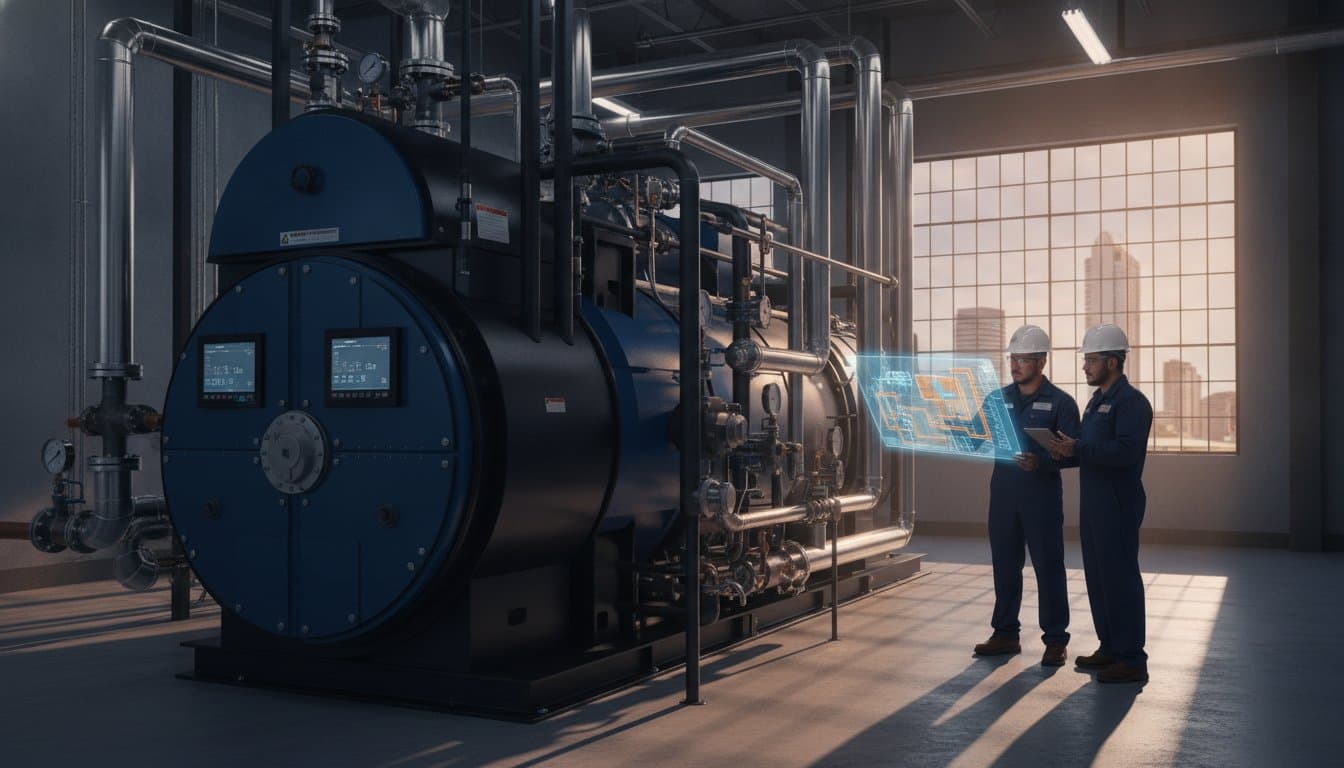
What if the primary cause of your facility's operational risk is not the mechanical equipment itself, but a lack of digital foresight during the initial engineering phase? In the high-stakes environment of large-scale mechanical systems, a single miscalculation in sizing or a spatial clash in piping can lead to catastrophic change orders and extended system downtime. We recognize that facility managers across Texas, from Austin to the Rio Grande Valley, require more than just a functional unit; they demand a system that adheres to rigorous Texas Department of Licensing and Regulation safety codes while maximizing long-term energy efficiency. This article serves as a comprehensive technical reference for commercial boiler installation in 2026, focusing on the strategic integration of Building Information Modeling (BIM) and in-house fabrication to ensure absolute precision.
You will learn how to navigate the complexities of modern engineering standards, from initial load calculations to the final verification of code compliance. By prioritizing meticulous preparation over reactive field-fits, you can secure a reliable heating infrastructure that minimizes maintenance costs and operational friction for the duration of its lifecycle. This guide provides the logical framework necessary to transition from traditional installation methods to a more disciplined, technology-driven approach that guarantees project integrity and long-term stability.
Key Takeaways
- Identify the engineering distinctions between high-mass and low-mass boiler technologies to determine the optimal thermal configuration for complex industrial infrastructures.
- Utilize ASHRAE 90.1 standards for rigorous load assessments, replacing antiquated sizing estimates with data-driven calculations that mitigate the risk of system downtime.
- Leverage Building Information Modeling (BIM) for pre-construction clash detection, ensuring that your commercial boiler installation is executed with the surgical precision required for modern mechanical standards.
- Analyze the mechanism of latent heat recovery within high-efficiency condensing systems to achieve superior thermal ratings and sustainable energy consumption profiles.
- Establish a robust framework for operational stability through specialized water chemistry protocols and preventive maintenance programs that align with current Texas boiler safety regulations.
Table of Contents
- Understanding Commercial Boiler Infrastructure and Thermal Requirements
- Engineering Precision: Sizing and Load Calculation Protocols
- Strategic Selection: High-Efficiency Condensing vs. Traditional Systems
- The Installation Lifecycle: BIM Coordination and Texas Compliance
- Operational Stability: Post-Installation Maintenance and Lifecycle
Understanding Commercial Boiler Infrastructure and Thermal Requirements
The boiler serves as the central thermal heart of any large-scale mechanical system, acting as the primary engine that drives climate control and industrial processes. Unlike light-commercial units that prioritize simple installation over long-term durability, a sophisticated commercial boiler installation requires a disciplined engineering approach to manage immense pressures and fluctuating thermal demands. In the current industrial environment, facility managers must distinguish between the specialized requirements of space heating, which focuses on occupant comfort, and process heating, which demands precise temperature control for manufacturing or sterilization tasks.
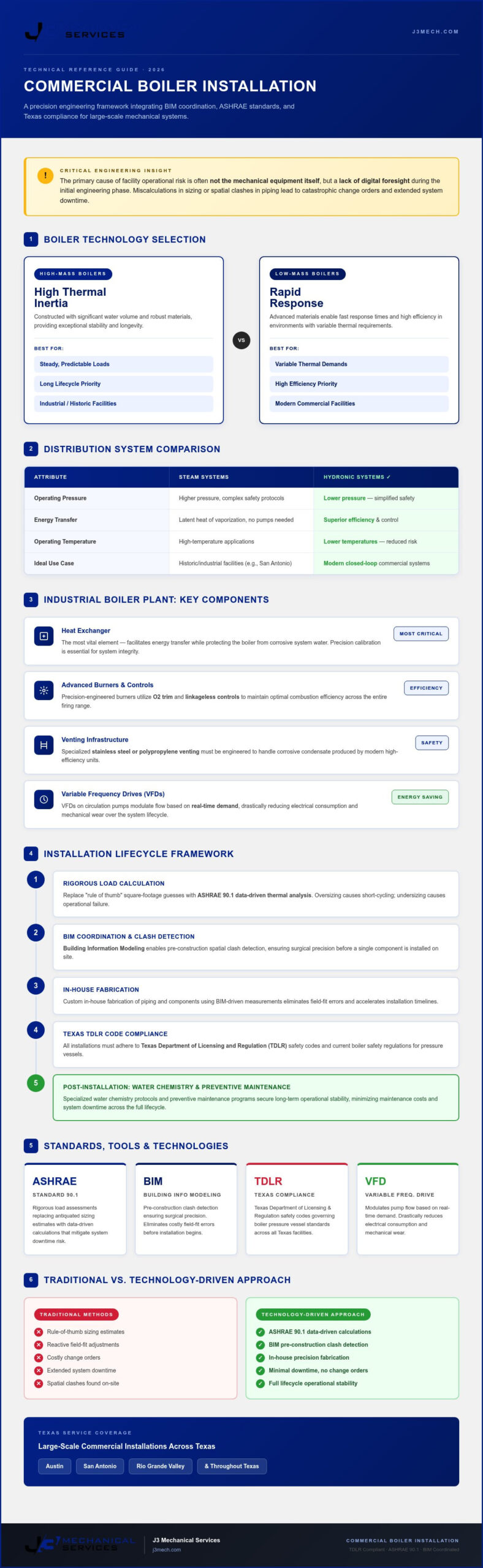
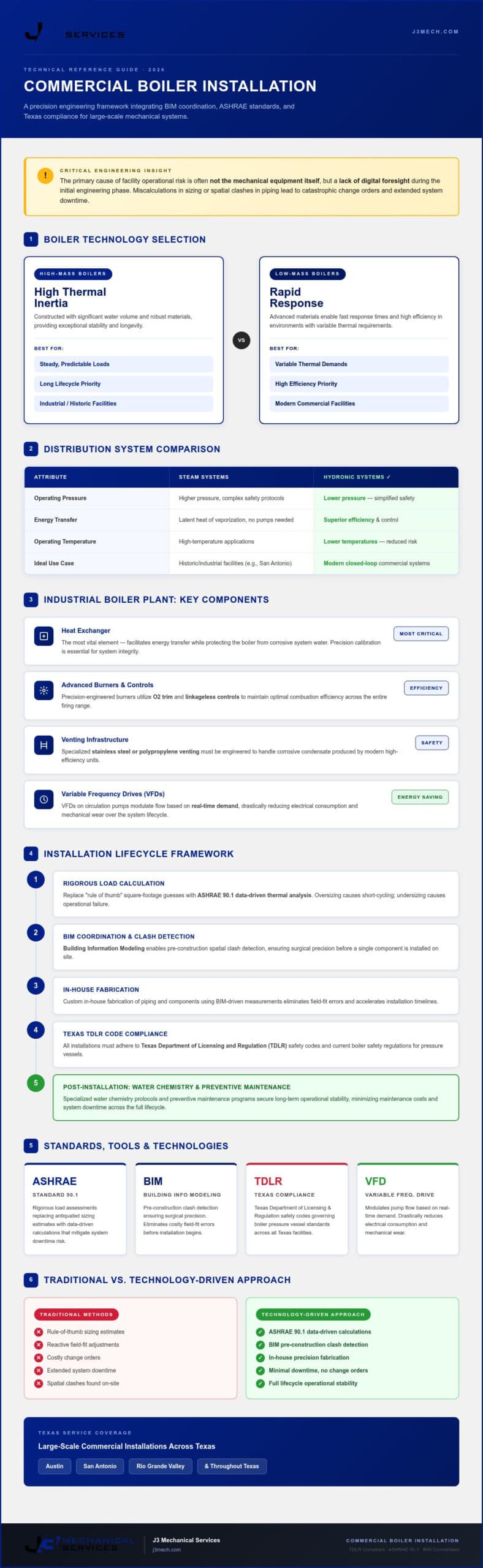
As we move into 2026, the industry is witnessing a strategic shift between high-mass and low-mass boiler technologies. High-mass boilers, constructed with significant water volume and robust materials, provide exceptional thermal inertia and longevity, making them ideal for facilities with steady, predictable loads. Conversely, low-mass units utilize advanced materials to achieve rapid response times and high efficiency in environments with highly variable thermal requirements. Selecting the correct technology is not merely a matter of preference but a critical engineering decision that affects the system's operational stability and maintenance lifecycle.
Steam vs. Hydronic Heating Systems
The choice between steam and hydronic distribution often depends on the existing infrastructure of the asset. Many historic or industrial facilities in San Antonio continue to rely on steam distribution, utilizing the latent heat of vaporization to move energy through complex piping networks without the need for pumps. While steam systems are effective for high-temperature applications, modern closed-loop hydronic systems offer superior efficiency and control. These water-based systems operate at lower temperatures and pressures, significantly reducing the risks associated with pressure vessel ratings and simplifying building safety protocols. Engineering a transition from steam to hydronic requires meticulous planning to ensure the new system can meet the existing thermal load without requiring a total building overhaul.
Primary Components of an Industrial Boiler Plant
A high-performance boiler plant is a synchronized assembly of critical components, each requiring precise calibration to maintain system integrity. The heat exchanger remains the most vital element, facilitating the transfer of energy while protecting the boiler from the corrosive effects of system water. To achieve the rigorous standards expected in 2026, these plants must integrate several key technologies:
- Advanced Burners and Controls: Precision-engineered burners utilize O2 trim and linkageless controls to maintain optimal combustion efficiency across the entire firing range.
- Venting Infrastructure: Specialized stainless steel or polypropylene venting must be engineered to handle the corrosive condensate produced by modern high-efficiency units.
- Variable Frequency Drives (VFDs): Integration of VFDs on circulation pumps allows the system to modulate flow based on real-time demand, drastically reducing electrical consumption and mechanical wear.
By viewing the commercial boiler installation as a holistic engineering project rather than a simple equipment replacement, facility managers can ensure their infrastructure remains resilient against the evolving demands of the Texas industrial sector.
Engineering Precision: Sizing and Load Calculation Protocols
Engineering precision begins with a rejection of the "rule of thumb" methodology that has historically plagued the mechanical industry. In a professional commercial boiler installation, sizing isn't merely a guess based on square footage but a rigorous calculation of the building's thermal dynamics. When a system is oversized, it suffers from chronic short-cycling, where the burner frequently ignites and extinguishes. This process doesn't just waste energy; it places undue thermal stress on the heat exchanger, leading to premature metal fatigue and system failure long before the equipment reaches its expected service life.
Beyond basic load matching, engineers must account for "pick-up loads." These are the energy requirements needed to bring a system from a cold start to operating temperature after a period of inactivity. If these loads are ignored, the system may fail to maintain comfort during rapid temperature drops typical of the Texas climate, where a building's thermal mass can absorb significant energy before the air temperature stabilizes.
The Impact of ASHRAE Standards on System Selection
Adhering to ASHRAE 90.1 standards is essential for achieving the energy efficiency minimums required for new construction across Texas. These standards demand a comprehensive assessment of the building envelope, ensuring that the selected boiler integrates seamlessly with the facility's insulation and glazing. Peak load requirements vary significantly between the humid, subtropical environment of the Rio Grande Valley and the more volatile temperature swings of Central Texas. Manual N load calculations represent the industry-standard procedure for performing professional-grade, room-by-room heat loss and gain analysis for commercial structures.
Advanced Heat Loss Survey Methodology
A modern thermal profile requires an exhaustive evaluation of insulation R-values, glazing U-factors, and air infiltration rates to determine the exact energy demand. Our methodology utilizes Building Information Modeling (BIM) to perform highly accurate volume calculations, ensuring that the physical space and the mechanical capacity are perfectly aligned. This digital foresight allows us to account for domestic hot water (DHW) integration in multi-use facilities, where the demand for potable hot water may peak at different times than the space heating load. Integrating these variables into a single, cohesive engineering model is how we mitigate risk during HVAC new construction projects. By identifying these requirements during the pre-construction phase of a commercial boiler installation, we eliminate the need for costly field adjustments and ensure the final installation meets the exact specifications of the building's operational reality.
Strategic Selection: High-Efficiency Condensing vs. Traditional Systems
Selecting the appropriate boiler technology is a strategic decision that dictates a facility's operational expenditure for decades. As we enter 2026, the distinction between Thermal Efficiency (TE) and AFUE ratings has become more pronounced in industrial engineering standards. While AFUE is a standard metric for smaller units, TE provides a more accurate reflection of how effectively a large-scale plant converts fuel into usable heat. The industry's shift toward high-efficiency condensing technology is driven by the mechanism of latent heat recovery. By cooling flue gases until the water vapor reverts to a liquid state, these systems capture energy that traditional units would otherwise exhaust into the atmosphere, often achieving thermal efficiencies exceeding 90 percent.
Material selection is a critical factor in ensuring the system's longevity. Stainless steel has emerged as the preferred material for condensing heat exchangers due to its exceptional resistance to the acidic condensate produced during energy recovery. In contrast, cast iron remains a staple for non-condensing applications, valued for its durability and thermal mass in high-temperature environments. Fuel source logistics also require careful consideration during the planning phase. Most modern installations prioritize natural gas, yet many industrial facilities utilize dual-fuel burners to allow for a seamless transition to propane, ensuring operational continuity during primary fuel supply interruptions.
High-Efficiency Condensing Boiler Advantages
Condensing boilers deliver maximum energy savings when they operate at lower return-water temperatures, typically below 130 degrees Fahrenheit. These units utilize advanced modulation ratios, which allow the burner to scale its output to match real-time building demand with surgical precision. This capability prevents the energy waste associated with the frequent cycling of older, atmospheric equipment. However, a commercial boiler installation involving condensing technology requires specialized venting infrastructure. Because the flue gases are cool and saturated, installers must utilize pressure-rated PVC, CPVC, or specialized stainless steel piping to manage the corrosive condensate safely and effectively.
Traditional Non-Condensing Systems in Industrial Contexts
Traditional non-condensing systems still hold a place in the industrial market, particularly for retrofits where existing heat emitters require high-temperature water or steam. In these scenarios, the cost of upgrading the entire distribution network to support condensing temperatures may not be justifiable. These systems generally involve a lower initial capital expenditure, though they result in higher long-term fuel costs. For facilities requiring high-pressure steam for process heating or sterilization, a traditional cast-iron or steel-tube boiler remains the engineering standard. When executing a commercial boiler installation in these environments, the focus shifts toward maximizing the efficiency of the burner-linkage systems and improving the insulation of the pressure vessel to mitigate standby heat loss.
The Installation Lifecycle: BIM Coordination and Texas Compliance
Project execution requires a disciplined transition from theoretical design to logistical reality. A successful commercial boiler installation is won or lost in the pre-construction phase, where engineering foresight replaces reactive field adjustments. By treating the mechanical room as a synchronized industrial environment, we ensure that every component is placed with surgical precision, minimizing the risk of costly change orders or delayed timelines. This methodical approach is particularly critical when integrating modern, high-efficiency systems into the existing infrastructure of occupied facilities.
To achieve this level of accuracy, our process leverages the logistical precision of in-house fabrication for boiler headers and complex piping assemblies. By shifting a significant portion of the assembly work from the field to a controlled shop environment, we maintain higher quality standards and tighter tolerances. This strategy allows for a phased installation that minimizes downtime, ensuring that critical facilities such as hospitals or manufacturing plants remain operational while the new thermal plant is brought online. The final stage of the lifecycle involves rigorous system commissioning, where every sensor and safety interlock is verified before the plant is integrated into the facility's Building Automation System (BAS).
BIM Coordination for Complex Mechanical Rooms
Building Information Modeling (BIM) serves as the foundation of our coordination strategy, allowing us to identify and resolve physical clashes before equipment ever reaches the site. In the tight mechanical quarters of historic San Antonio or Austin buildings, mapping existing utilities in three dimensions is essential for ensuring code-mandated access and serviceability. This digital modeling process ensures that every valve, pump, and venting run has adequate clearance, preventing the "field-fit" errors that frequently plague less disciplined projects. Using BIM allows us to verify that the commercial boiler installation aligns perfectly with the architectural and structural realities of the asset, providing a level of project control that traditional 2D drafting cannot match.
Navigating Texas Boiler Inspection and Safety Codes
Compliance with the Texas Department of Licensing and Regulation (TDLR) Boiler Program is a fundamental requirement that demands expert oversight. Our teams ensure that every pressure vessel and piping run adheres to strict state safety codes, including the mandatory CSD-1 testing protocols. These tests verify the integrity of safety interlocks, such as low-water cutoffs and high-limit pressure controls, which are vital for protecting the facility and its occupants. For a deeper analysis of how these standards integrate into a broader mechanical strategy, you can review our reference on Commercial HVAC Installation: Strategic Engineering for 2026. Our commitment to these rigorous standards ensures that your facility remains fully compliant with all state regulations while operating at peak safety. If you are planning a high-stakes mechanical upgrade, our team provides the technical mastery required for BIM-coordinated HVAC new construction and system replacements.
Operational Stability: Post-Installation Maintenance and Lifecycle
The conclusion of a commercial boiler installation marks the beginning of its operational lifecycle, where the focus shifts from engineering precision to long-term stability. A systematic transition to a comprehensive Preventive Maintenance (PM) program is essential for protecting the capital investment and ensuring the system performs to its design specifications. Without a disciplined approach to oversight, even the most advanced mechanical plants can succumb to premature degradation. For facilities that have inherited legacy systems requiring immediate attention, we offer specialized insights into Restoring Performance in Commercial Environments to bridge the gap between failure and reliability. Our accountability doesn't end at system startup; it extends through every phase of the equipment's service life.
In-house fabrication plays a vital role in this long-term stability that many competitors overlook. By utilizing custom-fabricated headers and piping assemblies, we ensure that the layout of the mechanical room is optimized for serviceability. This means that critical components are positioned for easy access, allowing technicians to perform inspections and repairs without the logistical friction often caused by cramped, "field-fit" arrangements. For critical infrastructure, J3 Mechanical Services maintains 24/7 emergency monitoring and response protocols, providing a layer of steadfast reliability that protects your facility against unforeseen interruptions. When unexpected mechanical failures do occur, having access to precision commercial HVAC repair services that address root causes rather than surface symptoms is essential for restoring operational continuity without delay.
Water Quality Management for Hydronic Loops
Texas is known for high mineral content in its water supply, which presents a significant risk to heat exchanger integrity. Scale accumulation acts as an insulator, forcing the boiler to work harder and significantly reducing thermal efficiency. Monitoring pH levels and glycol concentrations within hydronic loops is a non-negotiable requirement for modern systems. Industrial plants should implement automated chemical feed systems to maintain consistent water chemistry, as manual dosing is often too reactive to prevent long-term corrosion. By maintaining strict control over water quality, you protect the stainless steel or cast-iron components from the aggressive environment of a high-temperature thermal loop.
Integrating Boilers into Smart Building Ecosystems
Integrating the boiler plant into the facility's Building Automation System (BAS) allows for remote diagnostics and real-time performance tracking. This digital oversight enables predictive maintenance, where engineers identify potential failure points before they trigger actual downtime. By analyzing data trends in firing rates and flue temperatures, facility managers can move from a reactive posture to one of total project control. This data-driven approach ensures that the commercial boiler installation continues to deliver the energy efficiency promised during the design phase. To ensure your next project benefits from this level of engineering foresight, Consult with J3 Mechanical Services for a BIM-coordinated boiler installation strategy.
Securing Industrial Thermal Infrastructure for the Decades Ahead
Securing the long-term integrity of an industrial facility requires a transition from reactive maintenance to disciplined, engineering-led foresight. This reference has outlined the critical necessity of adhering to ASHRAE standards for load calculations and the strategic advantages of high-efficiency condensing technology. By prioritizing Building Information Modeling (BIM) during the pre-construction phase, facility managers can eliminate the spatial conflicts that lead to costly project delays. Executing a successful commercial boiler installation in 2026 demands a partner who views mechanical infrastructure as a mission-critical responsibility rather than a simple equipment replacement.
Our methodology ensures project success through BIM-coordinated delivery and the logistical precision of in-house fabrication, providing industrial facilities across Texas with a reliable, code-compliant thermal plant. From San Antonio to the Rio Grande Valley, we provide the technical mastery needed to manage complex mechanical environments without friction. It's time to elevate your facility's operational standards through precise engineering and proactive risk mitigation. Schedule a Strategic Consultation for Your Commercial Boiler Project
Frequently Asked Questions
How long does a typical commercial boiler installation take?
A standard commercial boiler installation usually spans one to three weeks depending on the complexity of the existing infrastructure and rigging requirements. While simple changeouts are faster, industrial retrofits often require more time for piping modifications and system integration. We utilize shop-fabricated components to expedite the field timeline, ensuring that your facility returns to full operational capacity as quickly as possible without compromising quality.
What are the TDLR requirements for commercial boiler inspections in Texas?
The Texas Department of Licensing and Regulation (TDLR) requires high-pressure steam boilers to undergo internal inspections annually, while most hot water heating boilers follow a biennial two-year cycle. Adhering to these intervals is a legal mandate that ensures your pressure vessels meet the safety standards defined by the Texas Boiler Law. These inspections typically involve verifying safety interlocks and assessing the vessel for signs of thermal stress or corrosion.
Can I replace a steam boiler with a high-efficiency hydronic system?
Replacing a steam boiler with a hydronic system is an effective way to improve efficiency, though it requires a detailed analysis of your existing terminal units. Steam radiators are designed for higher temperatures, so a conversion often necessitates either larger heat emitters or a system designed to handle lower return-water temperatures. Our engineering team evaluates the building's thermal mass to determine if a full hydronic conversion is the most stable path forward.
How much energy can I save by upgrading to a condensing boiler?
Upgrading to a condensing unit can reduce fuel consumption by significant margins, as these systems target Thermal Efficiency (TE) ratings of 90 percent or higher. Traditional non-condensing units often lose energy through flue gases, but condensing technology captures this latent heat through advanced heat exchanger designs. To realize these savings, the system must be engineered to operate at lower return temperatures, allowing the condensation process to occur consistently throughout the heating season.
What is the difference between a hot water boiler and a steam boiler for a commercial building?
A steam boiler utilizes the latent heat of vaporization to move energy through a building, while a hot water boiler circulates liquid at lower pressures and temperatures. Steam is often necessary for specific industrial processes or historic assets with existing piping, but hot water systems are the modern standard for space heating due to their superior control and safety. The decision depends on your specific load requirements and the limitations of your current distribution network.
Why is BIM coordination important for boiler room retrofits?
BIM coordination is vital for a commercial boiler installation because it allows engineers to map out mechanical rooms in three dimensions, identifying pipe clashes before they reach the site. This digital foresight is particularly important in tight industrial spaces where every inch of clearance counts for code compliance and future serviceability. Using these models ensures that the final physical installation matches the engineering design with surgical precision.
What maintenance is required for a new commercial boiler system?
Modern boiler maintenance focuses on three critical pillars: water chemistry, burner calibration, and CSD-1 safety testing. Automated chemical feed systems are recommended to prevent scale buildup in the heat exchangers, which is a common issue with Texas hard water. Regular verification of safety interlocks, such as low-water cutoffs and pressure limits, is also required to maintain operational stability and comply with state safety regulations.
Does J3 Mechanical Services provide in-house fabrication for boiler piping?
Yes, J3 Mechanical Services provides in-house fabrication for all piping assemblies and boiler headers to ensure the highest level of project control. By fabricating components in a controlled environment, we maintain tighter tolerances and higher weld quality than what is typically achievable in the field. This disciplined approach reduces onsite labor and ensures that your mechanical infrastructure is built to survive the rigors of long-term industrial use. For facilities managing both heating and cooling infrastructure, understanding how to respond to a cooling system failure is equally critical; our commercial ac repair near me emergency recovery checklist provides a structured framework for restoring operational continuity when cooling systems fail unexpectedly.
Need a hand with your building's HVAC?
Free quotes and honest answers from licensed commercial technicians across South Texas.