
Commercial Boiler Maintenance in Texas: A 2026 Facility Manager’s Checklist
The margin for error in mechanical infrastructure has vanished as the Texas Department of Licensing and Regulation now imposes daily penalties of up to $100 for overdue inspections. You likely understand that unscheduled downtime during a critical production cycle is more than an inconvenience; it's a failure of system coordination that threatens your operational budget and facility safety. Executing a disciplined strategy for commercial boiler maintenance Texas requires more than a casual inspection. It demands a systematic verification of every component to ensure both combustion efficiency and strict regulatory adherence.
This comprehensive 2026 checklist provides the technical roadmap necessary to optimize your equipment's lifecycle while navigating the latest state mandates. We'll detail the mandatory blowdown separator requirements, the 2026 carbon monoxide monitoring protocols, and the upcoming Department of Energy efficiency standards that will redefine commercial heating by October. By following this methodical approach, you can ensure your facility remains a model of industrial precision and fiscal responsibility.
Key Takeaways
- Identify how regional climatic factors, ranging from coastal humidity to inland temperature fluctuations, accelerate component oxidation and necessitate localized maintenance strategies.
- Execute a rigorous commercial boiler maintenance Texas checklist that prioritizes combustion analysis and heat exchanger verification to maintain peak thermal efficiency.
- Navigate the 2026 TDLR regulatory landscape by understanding the specific distinctions between mandatory certification inspections and comprehensive preventative engineering.
- Evaluate potential mechanical partners through the lens of technical mastery, ensuring they possess the in-house fabrication capabilities required for rapid system restoration.
- Transition from reactive repairs to a disciplined, strategist-led maintenance model that stabilizes operational budgets and extends equipment service life.
Table of Contents
- The Strategic Importance of Commercial Boiler Maintenance in Texas
- The Essential 2026 Commercial Boiler Maintenance Checklist
- Evaluating Commercial HVAC Companies for Long-Term Service Contracts
- Navigating Texas Boiler Regulations and Efficiency Standards
- J3 Mechanical Services: Precision Engineering for Boiler Reliability
The Strategic Importance of Commercial Boiler Maintenance in Texas
A Boiler represents the heart of a facility's thermal infrastructure, yet it's often the most overlooked component until a critical failure occurs. In high-stakes environments like San Antonio hospitals or Austin data centers, the relationship between consistent thermal precision and operational continuity isn't just a matter of convenience; it's a fundamental requirement for safety and production. Relying on an "emergency-only" mindset creates a volatile operational environment where rising energy costs and unscheduled downtime become inevitable. A disciplined approach to commercial boiler maintenance Texas transforms this equipment from a liability into a stable, predictable asset through rigorous technical oversight.
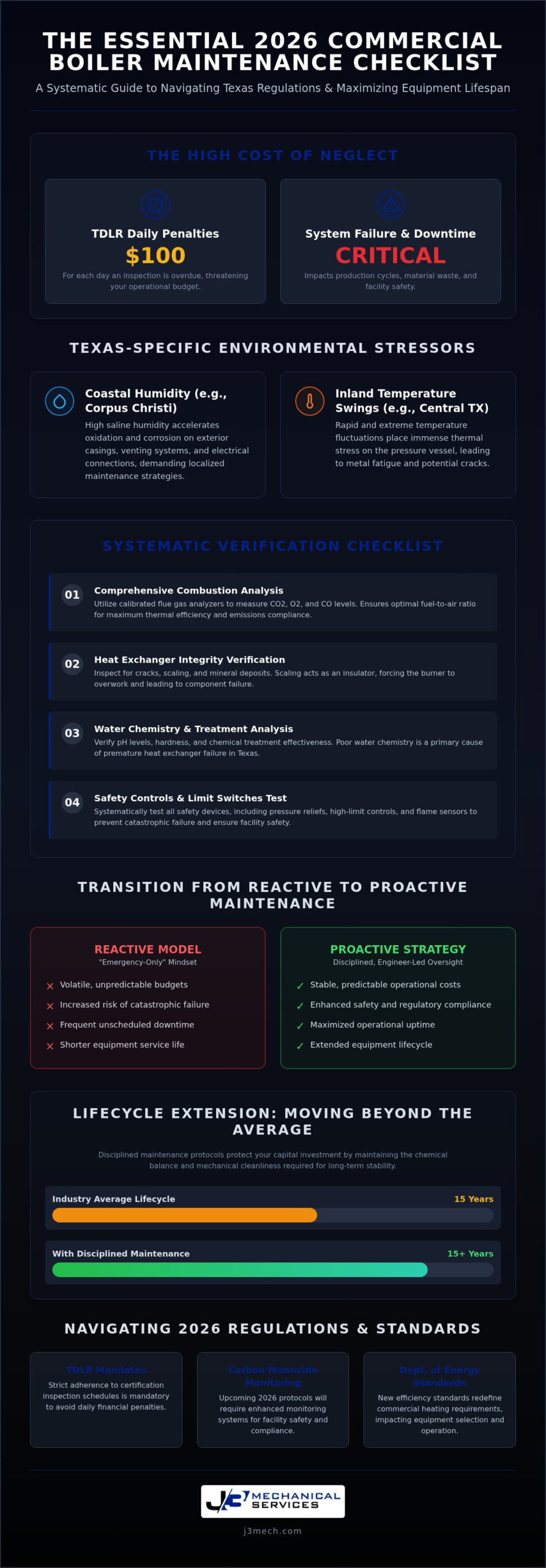
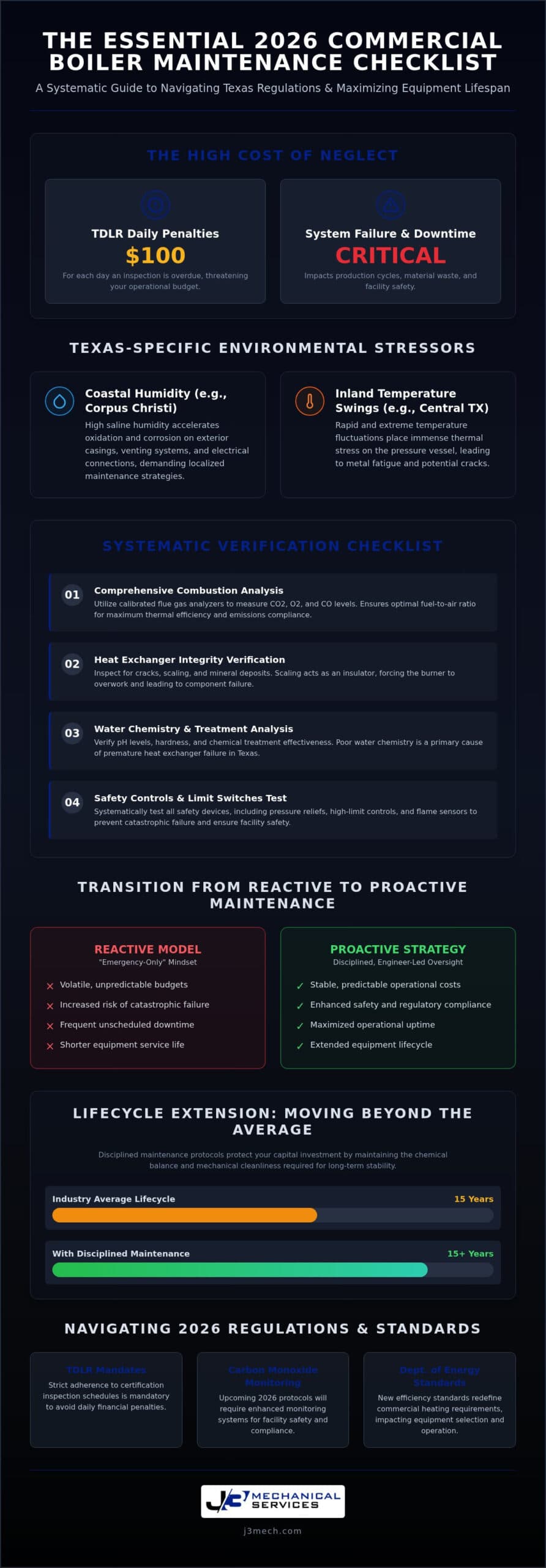
Texas presents unique environmental challenges that accelerate mechanical degradation. In coastal regions like Corpus Christi, high saline humidity levels catalyze oxidation on exterior casings and venting systems. Conversely, the rapid temperature swings characteristic of Central Texas place immense thermal stress on the pressure vessel, leading to metal fatigue. Systematic maintenance mitigates these regional risks by verifying the integrity of the system before environmental stressors trigger a catastrophic breach. This transition from reactive repair to planned mechanical oversight is the hallmark of a sophisticated facility management strategy.
Combating Operational Downtime in Industrial Environments
In production-heavy sectors, the true cost of an unscheduled shutdown extends far beyond the repair bill. It includes lost labor hours, wasted raw materials, and potential contractual penalties for missed delivery windows. Preventative protocols allow technicians to identify "invisible" failure points, such as hairline fractures in refractory material or slight deviations in gas pressure, before they lead to a system-wide lockout. By leveraging the expertise of specialized sheet metal contractors, facility managers ensure that custom venting and ductwork components are fabricated to precise tolerances, preventing the air-flow restrictions that often precede combustion failure.
Lifecycle Extension: Moving Beyond the 15-Year Average
While many industry standards suggest a 15-year lifecycle for commercial boilers, Central Texas facilities often see shorter durations due to poor water chemistry and irregular oversight. The correlation between water treatment precision and heat exchanger longevity is absolute. Scaling and mineral deposits act as insulators, forcing the burner to work harder and creating localized hotspots that eventually crack the heat exchanger. Disciplined maintenance protocols protect the significant capital investment of a commercial hvac installation by maintaining the chemical balance and mechanical cleanliness required for long-term stability. This proactive engineering ensures your infrastructure survives well past the industry average, providing a superior return on investment through predictable operational budgeting.
The Essential 2026 Commercial Boiler Maintenance Checklist
Executing a rigorous protocol for commercial boiler maintenance Texas isn't merely a compliance exercise; it's a systematic verification of mechanical integrity. A professional maintenance schedule serves as the primary defense against the combustion inefficiencies and safety failures that compromise industrial stability. This checklist provides a structured framework for facility managers to ensure every critical subsystem is evaluated with engineering precision. Understanding these technical requirements is essential when evaluating broader business hvac strategies for the upcoming fiscal cycle.
- Comprehensive Combustion Analysis: Technicians must utilize calibrated flue gas analyzers to measure carbon dioxide, oxygen, and carbon monoxide levels. This ensures an optimal fuel-to-air ratio, which maximizes thermal output while adhering to emissions standards.
- Heat Exchanger Integrity Verification: The heat exchanger requires a visual and ultrasonic inspection to detect stress fractures, mineral scaling, or signs of localized overheating that could lead to a catastrophic breach.
- Safety Control Redundancy Testing: All critical safety devices, including low-water cutoffs and high-limit switches, must be manually tripped to verify they effectively terminate the firing cycle during a fault condition.
- Burner Assembly Overhaul: This involves cleaning and adjusting pilot lights, inspecting nozzles for wear, and ensuring ignition electrodes are correctly gapped to prevent delayed ignition or flame failure.
- Instrumentation Calibration: Gauges, thermometers, and digital sensors must be calibrated against certified master instruments to guarantee that the control system receives accurate data for thermal reporting and modulation.
Waterside and Fireside Inspection Protocols
Precision in waterside maintenance is vital for preventing the mineral deposits that insulate heat transfer surfaces. Technicians must open the pressure vessel to inspect for scale buildup, which even in small amounts can drastically reduce energy efficiency. On the fireside, the removal of soot and combustion byproducts is necessary to prevent airflow restrictions and corrosive damage to the boiler tubes. Furthermore, the 2026 standards require testing condensate neutralizers and pumps to ensure acidic wastewater doesn't compromise the facility's drainage infrastructure.
Safety Device and Control System Verification
Facility managers must align their internal protocols with the latest Texas boiler regulations to avoid the significant daily penalties implemented in June 2026. This includes annual testing for ASME CSD-1 compliance, which verifies that all interlocks and fuel-train safety valves function within specified timeframes. The integrity of the pressure relief valve (PRV) and expansion tanks must be confirmed through bench testing or controlled lift tests. Finally, the fuel train must be checked for leaks, and gas pressure regulators must be verified to ensure they remain within the manufacturer's operational specifications.
Evaluating Commercial HVAC Companies for Long-Term Service Contracts
Selecting a mechanical partner for a long-term service contract requires a shift from simple vendor management to strategic infrastructure oversight. Technical mastery of business hvac systems remains a non-negotiable prerequisite, as modern boilers don't operate in isolation but function as a core component of a facility's integrated thermal network. A partner who embodies the "master builder" persona views their work through the lens of engineering integrity, ensuring every adjustment aligns with the rigorous standards set by Texas boiler regulations. For facilities located in the Rio Grande Valley or Round Rock, logistical capacity and rapid response times are essential to mitigate the risks of extended downtime. Transparency is equally vital; facility managers must demand comprehensive digital documentation that records every sensor reading, combustion adjustment, and safety test conducted during a site visit.
The Advantage of In-House Fabrication and BIM
Building Information Modeling (BIM) provides a digital framework for precise retrofitting, allowing technicians to simulate maintenance maneuvers before they're executed on-site. This coordination is supported by in-house fabrication, which significantly reduces lead times for custom boiler venting and flue components that would otherwise delay a project for weeks. Choosing a partner that functions as a leading commercial ac company in addition to their boiler expertise ensures a holistic understanding of the mechanical environment, providing a safer and more reliable outcome than a siloed "boiler-only" service provider. For developers planning new facilities in the region, understanding the principles behind commercial hvac new construction in San Antonio provides critical insight into how BIM-coordinated mechanical systems are engineered from the ground up to prevent the costly field corrections that plague less disciplined projects.
Vetting for Accountability and Ethical Standards
Accountability in commercial contracting is rooted in ethical consistency and a commitment to long-term system stability over the profit-driven "quick-fix" culture. A mechanical partner guided by faith-based principles provides a layer of reassurance through transparent pricing and honest assessments of equipment viability. When vetting potential contractors for commercial boiler maintenance Texas, facility managers should prioritize the following verification steps:
- Review the Experience Modification Rate (EMR) to assess the firm's historical safety performance and insurance stability.
- Verify that reporting includes time-stamped photographs of internal components during the fireside inspection to confirm thoroughness.
- Confirm the presence of a dedicated strategist who manages the lifecycle of the contract rather than relying on uncoordinated service calls.
- Ensure the contractor possesses the technical depth to manage complex control system calibrations without third-party intervention.
Navigating Texas Boiler Regulations and Efficiency Standards
The Texas Department of Licensing and Regulation (TDLR) maintains strict oversight of pressure vessel safety, yet many facility managers confuse a "Certificate of Operation" inspection with comprehensive commercial boiler maintenance Texas. While the state inspection verifies basic safety interlocks and structural integrity, it doesn't optimize the burner for thermal efficiency or address the gradual accumulation of fireside soot. Failing to maintain this distinction leads to more than just mechanical inefficiency; as of June 15, 2026, the TDLR has implemented aggressive late inspection fees starting at $25 per day and escalating to $100 per day after 60 days of expiration. Maintaining a detailed boiler log is essential for state inspectors and insurance adjusters alike, as it provides documented proof of systematic oversight and regulatory compliance.
TDLR Compliance and Inspection Cycles
High-pressure boilers in Texas generally require annual internal and external inspections, whereas low-pressure systems typically follow a biennial cycle. Your maintenance contractor must prepare the system for the Authorized Inspector (AI) by performing a full "lockout-tagout," opening the waterside and fireside for internal viewing, and cleaning all relevant surfaces. Proactive preventative maintenance avoids common citations such as missing blowdown separators, which became mandatory for all power boilers on May 1, 2025, or improper carbon monoxide monitoring. Current 2026 rules permit operation with CO levels up to 200 ppm only if remotely monitored, with mandatory alarms at 50 ppm.
Burner Efficiency and Emissions Standards
The regulatory landscape is shifting toward industrial decarbonization, with new Department of Energy standards taking effect on October 6, 2026, requiring condensing technology for most new commercial gas-fired water heaters. For existing large-scale assets, regular combustion tuning reduces the carbon footprint and aligns with corporate ESG goals while significantly lowering the frequency of commercial hvac repair. By prioritizing burner efficiency and emissions compliance, facility managers mitigate the risk of forced retrofits and ensure their infrastructure remains viable under increasingly stringent environmental laws. For a detailed audit of your system's current compliance status, you should schedule a professional assessment with J3 Mechanical Services.
J3 Mechanical Services: Precision Engineering for Boiler Reliability
J3 Mechanical Services functions as a disciplined strategist for your facility's mechanical infrastructure, moving beyond the limitations of reactive repair to provide comprehensive oversight across Central and South Texas. Our teams serve as authoritative experts in San Antonio, Austin, Corpus Christi, and the Rio Grande Valley, ensuring that every commercial boiler maintenance Texas contract is executed with industrial precision. We integrate 24/7 emergency recovery services with high-level preventative engineering to stabilize your operational environment. By utilizing advanced tools like Building Information Modeling (BIM) and maintaining in-house fabrication capabilities, we resolve complex piping and venting obstacles that frequently stall less-equipped contractors. Precision is our standard.
Our methodology is rooted in the "master builder" persona, where meticulous preparation and technical mastery define every site visit. When a system requires custom flue components or specialized ductwork, our in-house fabrication team produces these parts to exact tolerances, eliminating the logistical delays associated with third-party vendors. This vertical integration allows us to maintain total project control, ensuring that your boiler system remains both compliant with state mandates and optimized for peak combustion efficiency. We don't accept mediocrity in mechanical execution. Each phase of our maintenance process is designed to mitigate risk before it manifests as an operational liability.
Methodical Planning and Execution
We utilize a chronological flow in our maintenance contracts to ensure no component, from the smallest ignition electrode to the primary heat exchanger, is overlooked during our rigorous verification process. This systematic approach reflects the nature of large-scale commercial contracts, where rushing is a liability that can lead to catastrophic failure. We provide transparent, logic-driven reporting that documents every sensor calibration and adjustment made to your system during the 2026 service cycle. This level of accountability gives facility managers the data they need for predictable operational budgeting and total peace of mind regarding their critical infrastructure. It's a narrative of total project control.
Contact J3 for a System Assessment
Establishing a professional maintenance protocol is a strategic investment in your facility's long-term stability. J3 Mechanical Services offers comprehensive mechanical audits to identify efficiency gaps and regulatory risks before they manifest as costly failures. By partnering with a firm that prioritizes ethical consistency and technical rigor, you ensure your mechanical assets are managed by seasoned consultants who view their work as a critical responsibility. We invite you to take the first step toward securing your facility's thermal stability by requesting a professional system evaluation today.
Partner with J3 Mechanical for Disciplined Boiler Maintenance
Securing Long-Term Stability for Your Thermal Infrastructure
Maintaining the integrity of a commercial heating system requires a shift from superficial checks to a rigorous, engineering-led methodology. By adhering to a systematic checklist and understanding the nuances of the 2026 TDLR regulatory updates, facility managers effectively mitigate the risks of unscheduled downtime and escalating operational costs. A disciplined approach to commercial boiler maintenance Texas ensures that your infrastructure remains a stable asset rather than a liability. This stability is achieved through precise combustion tuning, water chemistry management, and the early identification of mechanical fatigue.
Partnering with a strategist who understands the complexity of large-scale mechanical projects provides the accountability necessary for high-stakes environments. J3 Mechanical Services delivers this expertise through BIM-coordinated mechanical solutions and specialized industrial fabrication capabilities that ensure rapid, precise component replacement. The same engineering discipline that drives our boiler maintenance programs also informs our approach to commercial hvac new construction in San Antonio, where precise load calculations and clash detection prevent the costly mid-construction corrections that compromise both project budgets and long-term system integrity. With a 24/7 emergency response network active across Central Texas, your facility is protected by a partner who views maintenance as a critical infrastructure responsibility. We're committed to helping you achieve a predictable operational budget and an extended equipment lifecycle.
Secure Your Facility with a J3 Preventative Maintenance Program
Frequently Asked Questions
How often is commercial boiler maintenance required in Texas?
The Texas Department of Licensing and Regulation mandates annual internal and external inspections for high-pressure power boilers, while low-pressure heating boilers typically follow a biennial cycle. However, professional commercial boiler maintenance Texas should occur quarterly or semi-annually to ensure the burner remains tuned for peak efficiency. This frequency allows technicians to identify minor deviations in gas pressure or water chemistry before they escalate into regulatory citations or mechanical failures.
What is the difference between a boiler inspection and boiler maintenance?
A state-mandated boiler inspection focuses exclusively on regulatory compliance and basic safety, verifying that pressure relief valves and low-water cutoffs function according to code. In contrast, comprehensive maintenance involves a systematic cleaning of the fireside and waterside surfaces, combustion analysis, and mechanical tuning. Maintenance is a proactive engineering discipline designed to optimize thermal transfer and extend the equipment's operational lifecycle beyond the limits of a simple safety check.
Does my commercial boiler need a Low-NOx burner to be compliant in 2026?
Compliance depends on your specific air quality district and the age of your equipment, as several Texas metropolitan areas enforce strict emissions limits for nitrogen oxides. While the 2026 Department of Energy standards prioritize condensing technology for new gas-fired water heaters, existing boilers may require Low-NOx burner retrofits during major overhauls to meet evolving local environmental mandates. We recommend a technical audit to determine if your current burner assembly aligns with these localized standards.
What are the signs that my commercial boiler requires immediate repair?
Immediate mechanical intervention is necessary if you observe "kettling" noises, which indicate localized overheating, or if soot accumulation appears around the burner assembly. Rapid fluctuations in pressure or a sudden, unexplained increase in fuel consumption often signal a breach in the heat exchanger or a failure in the modulation controls. Ignoring these indicators increases the risk of a system-wide lockout, potentially leading to the need for emergency commercial boiler maintenance Texas to restore facility operations.
How does hard water in Texas affect my boiler performance?
The high mineral content found in many Texas water supplies leads to rapid scale accumulation on the internal surfaces of the heat exchanger. These deposits act as a thermal insulator, forcing the burner to fire longer and hotter to achieve the desired temperature, which eventually causes metal fatigue and stress fractures. Precise water treatment and regular flushing are essential to mitigate this "hard water" effect and maintain the integrity of the pressure vessel.
Can J3 Mechanical handle boilers in specialized facilities like hospitals or schools?
J3 Mechanical Services specializes in high-stakes mechanical environments where operational continuity is a non-negotiable requirement for safety and compliance. Our team possesses the technical depth to manage the complex redundancies and rigorous air-quality standards inherent in hospitals, schools, and industrial production facilities. We apply a disciplined strategist's mindset to every project, ensuring that specialized infrastructure remains stable under the most demanding load conditions.
What should be included in a professional boiler maintenance report?
A professional maintenance report must provide a transparent, data-driven record of every technical adjustment and sensor calibration performed during the service visit. This includes time-stamped combustion analysis readings, documentation of safety interlock trip tests, and high-resolution photographs of the fireside refractory. These reports serve as a critical audit trail for state inspectors and insurance adjusters, demonstrating a commitment to meticulous preparation and industrial accountability.
How does BIM technology assist in boiler room retrofits?
Building Information Modeling (BIM) allows our engineering team to create a precise digital twin of your boiler room, facilitating the identification of spatial conflicts before physical work begins. This technology ensures that new piping, venting, and structural components are fabricated to exact specifications, significantly reducing the downtime associated with traditional field-fitting methods. By using BIM, we provide a narrative of total project control that streamlines the integration of modern, high-efficiency equipment into existing mechanical spaces.
Need a hand with your building's HVAC?
Free quotes and honest answers from licensed commercial technicians across South Texas.